Pages

Thursday, June 18, 2015

My Milky Way Expedition

I recently completed my first successful 'exploration' of photographing the Milky Way on the night of June 13, 2015 at Acadia National Park near Bar Harbor, Maine.  It was also my inauguration to simply witnessing the Milky Way's presence.  This had been a personal goal of mine for several months, requiring significant planning.

A little after 11pm on that Saturday night after driving about an hour to Acadia, I pulled into the parking lot adjacent to Sand Beach, and I took my equipment and various items out of my car.  I had rented from BorrowLenses a Canon 6D, a Rokinon 14mm f2.8 lens, and an intervalometer. Some bug spray, a headlamp, mace (for personal protection), my MeFOTO Roadtrip tripod, and hand-warmers were part of my "toolkit" (the hand-warmers were for wrapping around the lens rubber to prevent condensation from forming on the lens).  I also needed a caffeine pill to stay awake, considering I'd be out there until 3am!  Through prior research using applications such as Stellarium and Planit! Pro for Photographers, I already knew exactly when and where the Milky Way would be visible, as well as when the moon (nearly a new moon) would be below the horizon.

I walked down to Sand Beach, an ideal Milky Way viewing location, as it's set between rocky landscapes that block out most of the light pollution from nearby Bar Harbor.  It only took about a minute for my eyes to adjust enough in the dark to see it: a vague outline of what appeared to be a vast cloud extending from the southern horizon to the northern horizon.  It was a stunning sight. You can't really prepare yourself for its beauty if you've never seen it before.  I took a few moments to pause and appreciate what I was seeing up in those skies.  How sad it is that we waste so much electricity on our artificial lights and shun the darkness, blocking out most of the night sky!  

One of my initial shots -- some clouds interfered a bit
I set up my equipment and proceeded with some test shots after manually focusing the lens on a distant bright star.  The above photograph was one of my initial prized images appearing on the camera's image review screen -- with a full frame DSLR camera, you can capture the detail and colors far better than with the naked eye.  I could see that some clouds were blocking some of the Milky Way, so I waited them out for a few minutes -- the forecast called for mostly clear skies, a necessity for viewing purposes.  Of course, to my unaided eyes, that gorgeous sight in the sky looked much more like the processed image below - faint but beautiful.

To the naked eye, the Milky Way looked much like this
For the majority of my shots, I ended up using the following camera settings: ISO 2500, 25 second exposure, f/2.8.  White balance didn't matter since I was saving to RAW files that I could easily adjust in post processing.  The manual-focus wide-angle Rokinon lens captured a broad view of the skies. 

Whenever I needed to see what I was actually doing with my equipment, I used the red LED light on my headlamp.  Red light doesn't negatively impact our night vision as much as other light.  That's important because it takes several minutes for our eyes to adjust to the darkness, and any introduced light will biologically "reset" your eyesight to normal; thus, you have to wait a while once again to see the Milky Way with your own eyes.  

The red LED light from my headlamp added interesting effects in this shot
I didn't intend on spending all of my time at Sand Beach, as I'd heard Little Hunters Beach was also a great photographer's spot.  It is located further southwest just past Otter's Cove.  It was at Little Hunters Beach that I spent the majority of my time.  It seemed as though the skies were even darker there.  I decided to utilize the intervalometer to automate the process of photographing the night sky, to create a time lapse video.  While that was happening, it gave me time to see what my Canon T3 and 24mm lens could do.  I didn't expect much as it's not a full-frame DSLR and isn't built for night photography -- you have to utilize high ISO settings to photograph the Milky Way, which equates to a lot of noise in the resulting images.  My T3 surprisingly did okay, although nothing of the quality I'd want for making a print.

My Canon T3 and 24mm lens did surprisingly okay (though quite poor compared to the 6D) 
The 6D, on the other hand, gave me one of its best views in detail and color of the Milky Way on Little Hunters Beach, below.


I should have kept better track of the time -- a lesson learned for the next time I do a time lapse of the Milky Way.  I stopped the intervalometer far, far too soon; with 75 photographs taken, I was able to produce a brief three-second clip of the starry skies rotating across the horizon (although technically, it is the Earth that's rotating).  That you can see on YouTube in HD (see below) -- it'll flash by quickly, though!  Night sky time lapses are mesmerizing -- to see all of those stars in motion, you can easily visualize the concept that we exist on this tiny, fragile planet, spinning within an epic universe.
  

After Little Hunters Beach, I ventured to my final destination of the night -- atop Cadillac Mountain.  As I was winding my way to the top of the mountain in my Prius, I knew exactly what kind of moment I wanted to capture.  In the last bend in the road, there's a spot where you can pull over and look south toward Northeast Harbor.  The light pollution was heavier in that direction, but I could still clearly see in the skies our home galaxy's core.  I tested the view with the 6D, liked what I saw, and then set a twenty second delay on the timer.  That was plenty of time for me to hop across the large rocks toward the south and pose for the camera.  I gazed above at the Milky Way with my headlamp brightly shining up.  It was my 'selfie' of the night.  A meteor, shooting across the sky, photobombed that selfie.  I'll take it. :)

A selfie with the Milky Way, and a photobombing meteor
It was a fantastic experience -- one that I plan to do again in the future and improve upon.

I strongly encourage you to make your own journey to a locale dark enough to witness that gorgeous Milky Way in the night sky.  You'll need to get many miles away from the cities and suburbia (which may be difficult to do) to escape the light pollution that sadly makes the Milky Way invisible to over two-thirds of the US population and half of the world, according to a 2001 study.  To see the night skies in all of its vast beauty is to experience something beyond our daily modern lives of technology.  Something that may connect you to a larger, enlightening world.

Friday, February 6, 2015

The Snow Moon and Jupiter

On Tuesday (February 3, 2015), the Snow Moon (full moon in February) appeared to be best buds with Jupiter throughout the entire night.  They were within about 4.5 degrees of each other.  What does that mean?  If you hold your fist out at arm's length, 4.5 degrees would be a little less than half of your clenched fist.

New England has been experiencing a lot of snow and clouds in the last couple weeks, so we were lucky to have clear skies Tuesday night.  Getting photographs of the moon and Jupiter wasn't too difficult.  I was able to just step outside with a tripod and take some shots using a 75-300mm zoom lens and an 18-55 zoom lens.  The only two challenges were getting the moon into focus and getting the exposure correct.  You have to manually focus onto the moon, which requires a bit of finesse.  For the exposure, a full moon is so bright that the shot needs to be very quick, while Jupiter needs a longer exposure to gather enough light from the planet to be visible in the photograph.

I came up with three resulting images that I liked.  First, a wide angle view with trees in the foreground so that it'd be more interesting and also obvious on what you're looking at -- I intentionally over-exposed the shot for the moon as I really liked the star-like effect the moon gave off that way, and it was the only way for Jupiter to be visible at such a wide angle; second, a closer shot of just Jupiter and the moon; finally, a close-up photo of the Snow Moon.

@18mm
@135mm
@300mm

Sunday, February 1, 2015

Mount Auburn Cemetery in Winter

If you appreciate a beautiful garden cemetery, then you must visit Mount Auburn Cemetery along the border of Cambridge and Watertown, Massachusetts.  It is considered to be the first rural garden cemetery in the United States, founded in 1831, and designed to be a place to mourn but also to appreciate the natural beauty of the landscape.  It doesn't feel like a typical cemetery -- there is something otherworldly yet grounded about it.  Spanning across 170 acres of land, there is much to take in: the hills, the fauna and flora (particularly the diversity of birds and trees), the memorials, the monuments, and even the skyline views of Boston.

You could easily walk around the garden cemetery for several hours, perhaps an entire day, and still not see all that it offers.  I visited in October 2014 during the autumn revolution of colors, and in January 2015, I returned to get a new winter perspective as nearly three feet of snow covered the grounds.  It was an entirely different experience.

Story Chapel and the Administration Building
I chose to make my visit on a sunny late afternoon just three days after the blizzard Juno swept through.  During the couple hours prior to sunset, the bright light of the sun gradually shifts in color, then dramatically changes to a golden hue.  It's a perfect time to photograph.  The roads were mostly clear, and where it wasn't, the snow was fairly compacted.  The walking paths, however, were not cleared.  It meant that you simply had to appreciate the beauty of many sights from afar.  It also meant that grounds were clean and pristine, free of the salt and filth associated with plows and roads, and that amplified the gorgeousness of an untouched snow-covered landscape!


One of my favorite spots is Willow Pond, aptly named.  The willow tree (specifically, the weeping willow) is my most treasured type of tree. You would have had no idea a pond was there, as it was covered by ice and heavy snow.  The willows were in sight, however.  And as you can see here, that magical afternoon hour of sunlight made an impact on the willows' appearance.  You'd never know you were so close to a city here - it was so quiet and lovely.


At the edge of Halcyon Lake, the sharply defined, granite Mary Baker Eddy Monument is magnificent.  Mary Baker Eddy was the founder of Christian Science -- her name is associated with much in New England but especially Boston, where the Christian Science Plaza and "Mother Church" can be seen.  She was buried here at Mount Auburn Cemetery.  The design of the monument has such purpose and meaning -- which you can read more about through its hyper-linked name above.


The mausoleums at Mount Auburn Cemetery are diverse in terms of their structure and intricate designs.  The Lodge Tomb is one of my favorites (seen above).  It features this intriguing door -- yet it seems much more than a door.  The labor, love, and material spent to create it much have been great.  The shadows of the trees behind me added a layer of contrast to this scene.


The history of Mount Auburn Cemetery is lengthy and rich, and several books have been written about it.  One of them that I'd like to read is "Silent City on a Hill: Picturesque Landscapes of Memory and Boston's Mount Auburn Cemetery."  It seems like the perfect combination of written research and imagery.

Cherry Path in black & white
I look forward to seeing the way the spring brings about the flowers and other plant life.  Many of the walking paths bear names that refer to things we associate with flowers and fruits of spring and summer, such as cherries, lilacs, primroses, mayflowers, and tulips.  But Mount Auburn Cemetery is worth a visit in the winter, let alone any season!  

Monday, January 26, 2015

A January Adventure in Vermont

Every artist needs inspiration to fuel their passion.  It's easy for a photographer to find inspiration in their daily routines.  But you need something that completely breaks from your routine to kick-start new perspectives and ways to grow as an artist.  So in late January, I chose the state of Vermont as an expansive base from which to leap toward a photography adventure.  This seems like the right time to begin to use this blog to share my journeys with you -- to give you insight into the stories of my work.

I've selected a few photographs to highlight within this blog posting -- though they may not necessarily represent the very best of my work, they do a great job capturing my personal feelings and thoughts of various moments.  I've also set up a Google+ album that encompasses all of my favorite photographs from this trip, if you want to go beyond the highlights of this blog.  I encourage you to look through them!

So... let's begin, shall we?

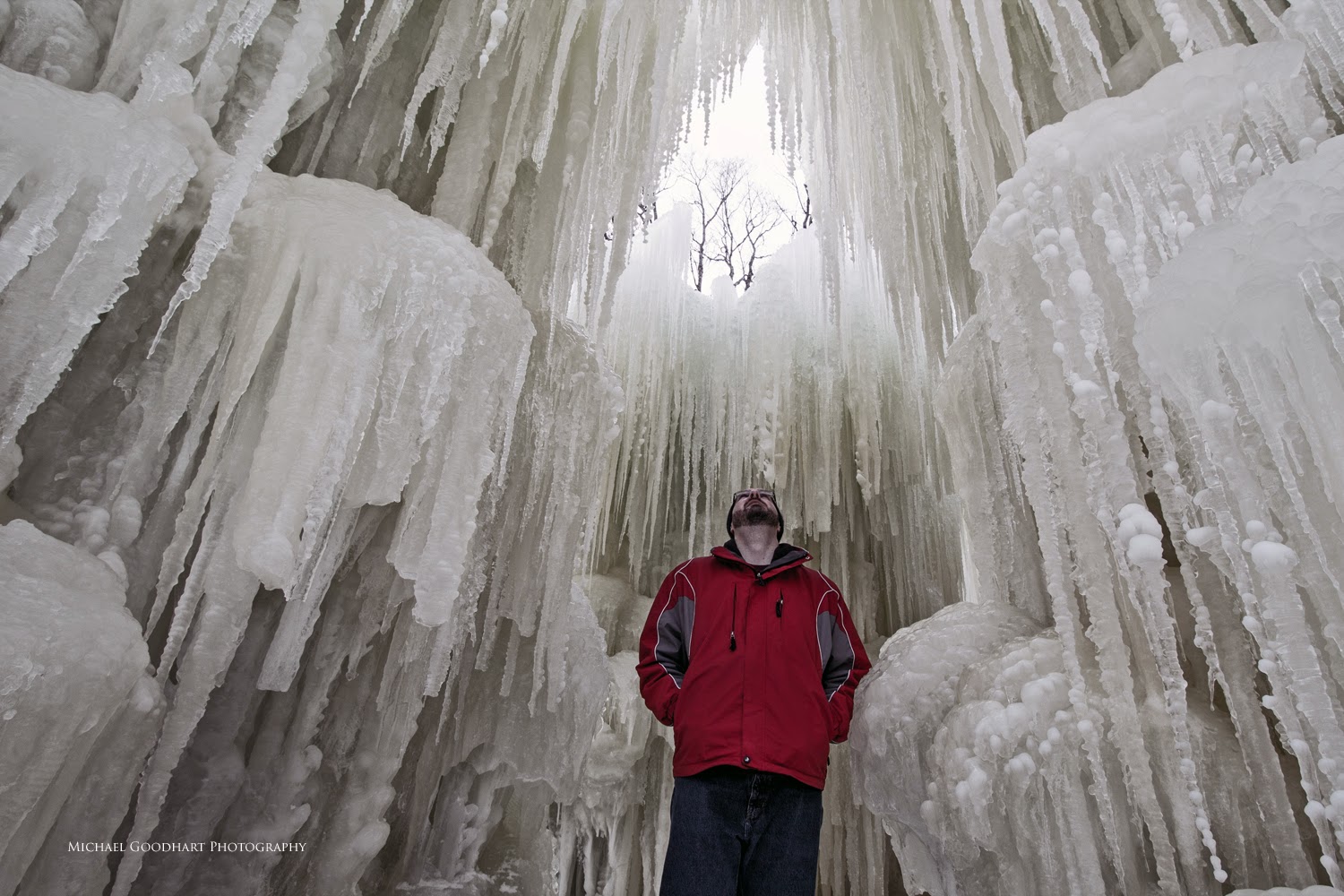
The first thing I wanted to do was visit the Ice Castles in the Sun Bowl of the Stratton Mountain Ski Area.  There are currently four ice castles in the United States, though the number changes from year to year.  They're all man-made through an array of pipes spraying water over the course of time, and the result is the creation of these visual masterpieces of icicles.  It's a small playground for the child soul within us.  I arrived about an hour before sunset to get the best of both worlds of day and night.


As the sky darkened, colorful lights turned on and set the ice-scape aglow.  It's a sight to behold.  


One structure was set up like a fountain, as water bubbled to the top as a geyser might do.  Colors shifted from white to yellow to blue to purple to red, repeating a simple, hypnotizing pattern.  

  
Visiting any of the Ice Castles won't set you back a lot of money -- it was about $14 for an entry ticket for one adult.  If you have a DSLR camera and a tripod, make sure you bring them!

During my weekend trip in Vermont, I also wanted to see Quechee Gorge, the deepest of its kind in the entire state.  From a bridge overlooking the gorge, it's about a 165 foot drop to the bottom.  Unfortunately, on my first full day of this adventure, steady snow showers inhibited a clear view.  The trails along the sides of the gorge were also off-limits, as a thick coating of ice made the hilly pathways dangerous... oh, but that didn't stop me.  I grabbed my camera bag and tripod, sat at the top of one of the small hills, and let gravity do the work as I slid down!  In case you're wondering how I'd get back up, I wasn't really thinking about that -- but thankfully the path eventually reconnected with the road (and I could walk back up that way).  The path made its way past an overlook of Mill Pond Falls, well worth the slide down!


The third and final goal for this journey was to get a glimpse of a few of the beautiful covered bridges of Vermont.  Covered bridges give us a look through an historical lens, when timber was used in the 18th and 19th centuries to cross the chasms of rivers.  It was an engineering marvel during those times.  Before this visit, I had no personal recollection of seeing a covered bridge with my own eyes.  I tried to hand-pick several bridges of diverse character.  

In the quaint New England town of Woodstock, home of three covered bridges, I ventured first to Middle Bridge that spanned across the Ottauquechee River (a river common to many of the bridges I happened to visit).  It was the only covered bridge I saw that featured a pedestrian walkway in addition to the vehicle pathway.  I vividly recall the overcast skies finally clearing, after I parked my car along the town commons and walked toward the bridge.  What a beautiful sight!

  
A few miles east along Woodstock Road (Route 4) is the Taftsville Covered Bridge, the second longest bridge in the state.  Featuring a bright red paint on its outer "skin," it is parallel to the Taftsville river dam (which can be seen along the left edge of this photo below).  I utilized HDR (high dynamic range imagery) photography to fuse together three photographs to get the detail in the extreme shadows and light, and I was really pleased with the results after some creative processing.


I used the same method to show a closer glimpse of the details of the timber truss structures inside the bridge.  The design, especially considering it came about in 1836, was impressive in its complexity and beauty!


An hour's drive northwest brought me to Cooley Bridge in Pittsford, Vermont.  It felt like the perfect archetype of a New England covered bridge, intimate in size yet immense in charm.  In that golden hour before the sun dips below the horizon, bright beams of light peeked through one end of the bridge and shimmered across the road on the other side.  Looking at the scene, I imagined that if something like heaven exists, this is the bridge that would get you there.


By the way, I adore sunsets -- particularly when partly cloudy skies reflect an eclectic, vivid splendor of color.  Along Stevens Road in Pittsford, I stopped my vehicle to witness a wide open stretch of open snow-covered land and stunning shades of red and purple lighting up the mountains on the horizon.  These are the moments that you can't help but savor.


During my two-night stay in Vermont, I called the Hotel Coolidge in White River Junction my temporary home away from home.  It was built first in 1849 and rebuilt in 1869 along a main railway.  It was named after President Calvin Coolidge's father, and President Coolidge even stayed at the hotel at one time (by the way, I borrowed this very brief historical synopsis from the hotel's web site).  The hotel shows its age but that's to be expected -- it's all part of the experience!  I recommend it, but definitely try getting a room facing away from the noisy, local bar -- learn from my lesson!   

Before I set off to come back home, I drove back to the bridge overlook of Quechee Gorge.  Blue skies had opened up again that Sunday morning.  Snow banks along the bridge made the photograph difficult, but I took a minor risk and climbed up the bank and leaned along the top of the bridge railing, determined to get that shot.  Yes.  This was a great way to end this adventure!


Monday, November 24, 2014

A Developing Picture

In the next few days, I'll be putting together this blog that will be a place to tell the stories behind my photography.  If you're reading this right now, please follow or bookmark my blog!  I appreciate everyone's support!

Best,
Michael